Community of Sant'Egidio

Newsflash


HOME PAGE

PREVIOUS PAGE

Rome, 20th February 2008
Piazza di S. Egidio
Conference
Middle-Eastern Christians on the Cusp of the Future, of Tradition and of Islam

Bringing a dramatic situation and forgotten suffering to the attention of the international community


Program (IT)


Saluto del Cardinale Leonardo Sandri

Intervento di Andrea Riccardi

Intervento del Cardinale Leonardo Sandri
dall'Osservatore Romano

Preghiera in Santa Maria in Trastevere per i cristiani in Medio Oriente: l'omelia del Cardinale Leonardo Sandri

 
“Eastern Christians represent the world of the origins, of the roots, of tradition: they are an undisputed connecting thread binding the Western part of the Catholic Church to its origins. They represent that other, non-Latin, non-European side of a Christianity which, born in the Middle East, has become European, and from Europe, has made itself universal […].
Following the Second Vatican Council, Rome’s attention has turned to include the non-Catholic Christian World”
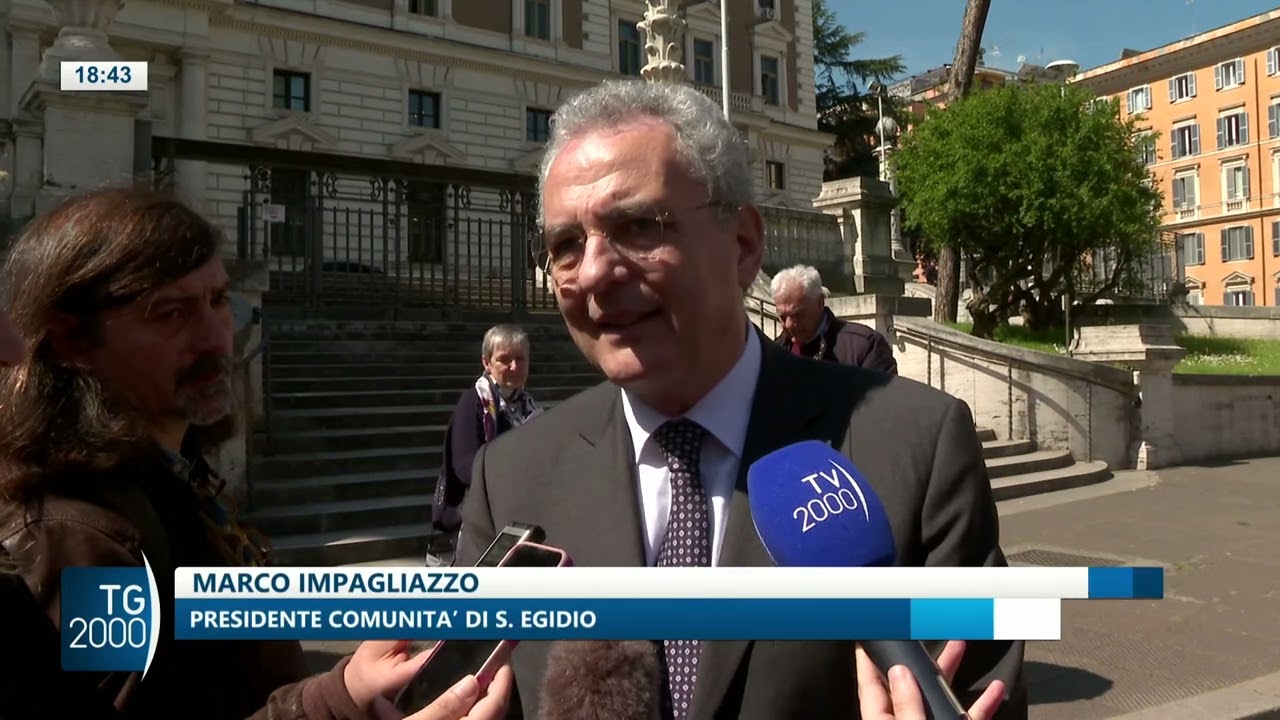
said Andrea Riccardi, opening the meeting held on Wednesday 20 February at the Community of Sant’Egidio. It was attended by Lebanon’s Foreign Minister, Tareq Mitri; by Régis Debray, Jean Sleiman, Latin-rite Archbishop of Baghdad; by Antoine Audo, Chaldean Bishop of Aleppo and there was – in the afternoon – a round table attended by Leonardo Sandri, Prefect of the Congregation of Eastern Churches, and a round table with Giuliano Ferrara, Lucio Caracciolo, Gianni Vernetti, Undersecretary for Foreign Affairs, Ambassador Huntzinger and Andrea Riccardi.

The Community of Sant’Egidio held this conference to draw attention to the fraught and all too often forgotten plights of Eastern Christians.

It is a point of increasing significance at a time in which Europe is being called upon to reconsider the frontiers of its responsibility, from the Middle East to the Balkans, to Africa.

The history of Sant’Egidio’s relationship with Eastern Christians is that of a friendship going back over twenty-five years, embracing the complex world of Eastern Christianity, including Catholic, Orthodox and the ancient Eastern Churches: Sant’Egidio has over the years been a place of prayer and of solidarity in the memories of Lebanon, of Iraq, and of Jerusalem.

Riccardi stressed the “complex Middle East” to explain the difficulties Europe has in perceiving this world, while at the same time showing how the Middle East has been discovered through Islam, the oil crisis during the seventies, through terrorism and fundamentalism.

“Not only have Christians been the victims of this history, as of a present that is pushing them towards the status of second-class citizens, they are also – in their own way – protagonists of the present […and for this reason] Christian communities are in need of sustenance, so that they are not left on their own, but part of an intense communion” Riccardi said on closing, stating that the Moslem world would, without the Christians, be destined to turn in on itself, adopting more totalitarian forms, because the two thousand year old presence of Christians provides that of an otherness.

Regis Debray observed how Eastern Christians are affected by marginalization, worsened by the fact that they do not fit into the traditional antagonisms between black and white, East and West, the North and the South of the world.
For Lebanon’s Foreign Minister, Tarq Mitri , his country symbolizes the Middle East, in which the problems of Christians – who are called to a vocation of witnesses of their faith – are the same as those of Moslems. “Our Churches are suffering; they are surviving but are cast thinly like salt, in the search for their identities” the Minister said, pointing out the semantic evolution of the word Christian: during the nineties one still spoke of Churches and of Christian Communities in the plural: they were a force of attraction in difficult regions, such as in his country. Today the talk is of the Christian Community in the singular, evoking a weakening, not just in demographic terms, but of participation in the eyes of the Middle Eastern world. This “uncivil” war has taken a whole country hostage, reducing it to a coin of exchange used to fight the wars of others. Mitri singled out a fault in Lebanon’s political system, where an opposition-representing democracy gives minorities the right to veto Parliamentary decisions, blocking the election of a President.

While outlining the difficulties of Christians in Iraq, Jean Benjamin Sleiman, Latin-rite Archbishop of Baghdad, said that there was Islamic-Christian cohabitation in some areas of the country. “I have celebrated weddings and funerals in the presence of Moslems”, Sleiman stated. Fundamentalism negates the other, not accepting tolerance: Iraqi Christians are its victims, but they are not alone; many Moslems are also suffering in the terrible violence that exists – and not just since yesterday – in the country. The Archbishop highlighted the contribution of Christians in Iraq to the construction of a non-violent, non-aggressive modernity, in which respect for the person as such prevails.

Antoine Audo, Chaldean Bishop of Aleppo, suggested that one should look beyond the difficulties and search for solutions, recalling the ancient roots of the Church in his country, Syria, where Christians feel they are at home, part of social life, while conserving their Christianity. What are the answers in such a complex situation? The Bishop singled them out in the unity of the Church, in ecumenical and in inter-religious dialogue: “the current situation has a need for meeting places in which Christians and Moslems can gather in an atmosphere of trust to exorcise their fears” Audo concluded.