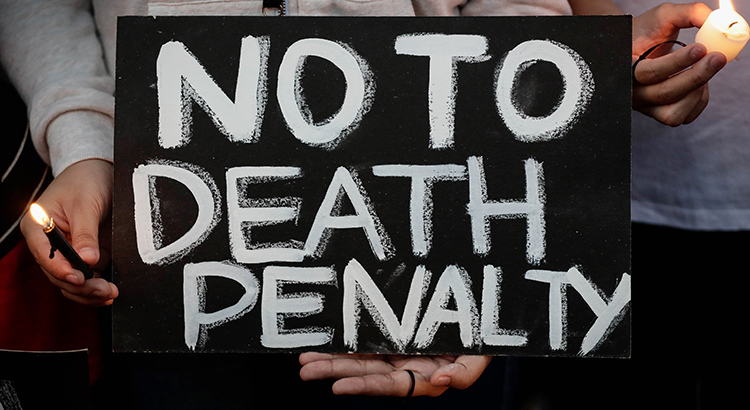
NO alla Pena di Morte
Campagna Internazionale 

pdm_s.gif (3224 byte)


Italiano

Putin Speaks Against Death Penalty

 MOSCOW  - President Vladimir Putin  expressed strong opposition Monday to the death penalty, saying Russia should not restore executions despite public support for them.

``The state must not claim the right to take human life away, which belongs only to the Almighty,'' Putin said at a Kremlin meeting with World Bank  President James Wolfensohn, according to the Interfax and ITAR-Tass news agencies.

Russia introduced a moratorium on the death penalty in 1996 as a condition for entrance to the Council of Europe, the continent's leading human rights watchdog. Russia has not banned capital punishment entirely.

Putin said he understands why opinion polls show most Russians support reviving the death penalty, blaming the view on the turmoil of the past decade since the collapse of the Soviet system.

Wolfensohn arrived in Russia on Sunday to open a conference on court reform and expressed support for Putin's pledges to overhaul Russia's cumbersome, often corrupt judicial system. 


July 11, 2001  

 Russian President Takes Stand Against Reviving Death Penalty

 MAURA REYNOLDS, TIMES STAFF WRITER

MOSCOW -- President Vladimir V. Putin's words were uncharacteristically strong and unequivocal--"I am against the restoration of capital punishment in Russia"--and they set off a fresh wave of controversy Tuesday over whether the country needs the death penalty.

The statement late Monday ended months of fence-sitting by the Russian president, torn between overwhelming support for the death penalty by his countrymen and overwhelming opposition to it in Western Europe.

"The state should not arrogate for itself a right which belongs only to the Almighty," Putin said after meeting with World Bank President James D. Wolfensohn. In order to retain membership in European organizations, Russia has been halfheartedly observing a moratorium on capital punishment since 1996, but the statute permitting its use remains on the books.

Russian polls show that about 80% of respondents favor the death penalty. Some judges have defied the Kremlin and continued to sentence people to death, although the sentences have not been carried out.

"For the time being, the majority of our people believe [the death penalty] should be left at least for intimidation," said Gennady N. Seleznyov, speaker of parliament's lower house, the State Duma. "What's the use of hurrying" to ban it?

Debate over capital punishment revived in Russia last month after a top general called for the execution of Chechen terrorists.

"When you look at it, it seems you'd strangle [these criminals] with your own hands," Putin said in his remarks. "But as a person who received a basic legal education, I know that a tougher penalty will not reduce crime."

It was perhaps the first time in Putin's presidency that he took a position clearly at odds with polls. He has frequently cited polls when he has taken public stands--for instance, when he reinstated the music of the Soviet anthem last winter.

But Sergei Kovalyov, Russia's most prominent human rights campaigner, said that when it comes to the death penalty, foreign policy trumps domestic policy.

"I don't think Putin is a convinced opponent of the death penalty," Kovalyov said. "But there is nothing else Russia can do. . . . The Kremlin's ultimate task in international relations is to drive a wedge between Europe and the United States." And for that, it must remain a member of European organizations.

Russia belongs to the Council of Europe, which requires that the death penalty not be imposed. Membership in the European Union, to which Russia aspires, requires membership in the Council of Europe.

Putin's position on the death penalty had been unclear in part because last year he stopped issuing presidential pardons. The practice was begun in 1996 by his predecessor, Boris N. Yeltsin, who used pardons to commute death sentences.

Early in his administration, Yeltsin established a presidential clemency commission as a safety valve in a justice system acknowledged as flawed and cruel. However, last year Putin for the most part stopped signing clemency petitions, in an apparent effort to appease the Justice Ministry, which administers prisons and disliked the interference.

In 2000, Putin approved more than 12,000 clemency requests. But in the last few months of the year, he issued only eight, and none this year, according to Anatoly Pristavkin, chairman of the clemency panel.

Critics say that if Russia had a fair and consistent justice system, there would be no reason to have a clemency commission. Prosecutors rely less on investigative evidence to prove their case than on suspects' confessions--which inmates say frequently are beaten out of them. Judges rarely rule against prosecutors in criminal cases, and jail terms tend to be long.

Putin has made judicial reform a top priority, but some of the proposed changes have been resisted by the Justice Ministry and other judicial bodies.

Pavel Krasheninnikov, chairman of the Duma's legislation committee, said parliament will 


Putin Speaks Against Death Penalty

By ANGELA CHARLTON, Associated Press Writer

MOSCOW  - President Vladimir Putin (news - web sites) insisted that Russia should not revive the death penalty, saying Monday that only ``the Almighty'' has the right to take life.

It was the ex-KGB agent's strongest public statement yet against the death penalty.

Russia suspended the practice in 1996 to gain entrance to Europe's leading human rights watchdog, the Council of Europe, but it still has widespread support among Russians.

``The state must not claim the right to take human life away, which belongs only to the Almighty,'' Putin said during a Kremlin meeting with European justice officials. ``I can tell you firmly I am against the renewal of the death penalty in Russia.''

Putin said he understands why opinion polls show most Russians support resuming capital punishment, blaming the turmoil of the decade since the collapse of the Soviet system and violence against Russians by ``international terrorists.''

He was referring to the nearly two-year war in Chechnya (news - web sites). Troops entered the republic in September 1999 after apartment bombings blamed on the Chechens killed about 300 people and Chechnya-based militants invaded a neighboring region.

``Many of our citizens were killed by those bandits. When one sees all this, one not only wants these bandits to be caught and tried, but - and I won't be afraid or ashamed to say this in this audience - sometimes it seems I would have strangled them with my own hands,'' he said Monday, in remarks carried on Russian television stations.

``But these are only emotions. As a man with a basic legal education ... I am well aware that the toughening of punishment does not lead to uprooting crime,'' he said. ``By toughening the punishment the government does not get rid of ruthlessness, it only generates it again and again.''

Russia has a centuries-old tradition of executions, and they were a key tool of terror in the Soviet police state. The disintegration of the Soviet system freed political prisoners, but it also spurred a rise in violent and organized crime.

Justice Minister Yuri Chaika recently proposed restoring the death penalty for convicted terrorists, and the commander of Russia's campaign in Chechnya, Gen. Gennady Troshev, called for Chechen rebels to be publicly executed.

Parliament has balked at outlawing capital punishment altogether, citing polls that show most Russians support the death penalty. But presidential aide Dmitry Kozak said Monday that the country has no plans to lift the moratorium.


  Vladimir Poutine contre le rétablissement de la peine de mort en Russie

MOSCOU (AP) -- Le président russe Vladimir Poutine a réaffirmé lundi que la Russie ne reviendrait pas sur la suppression de la peine de mort, décidée en 1996 pour entrer au Conseil de l'Europe.

''L'Etat ne doit pas s'arroger le droit de prendre une vie humaine, qui n'appartient qu'au Tout-Puissant'', a déclaré le chef du Kremlin, qui rencontrait à Moscou des responsables judiciaires européens. ''Je peux vous dire fermement que je suis contre le retour à la peine de mort en Russie''.

Vladimir Poutine a ajouté qu'il comprenait que l'opinion publique soit majoritairement favorable, selon des sondages, au rétablissement de la peine de mort, étant donné la situation du pays à cause de l'effondrement de l'Union soviétique il y a dix ans et des violences commises par ''les terroristes internationaux'', en l'occurrence les rebelles tchétchènes qui tiennent les troupes russes en échec depuis deux ans. Moscou leur impute les attentats qui ont fait environ 300 morts en 1999.

Pour le président russe, la priorité est de réformer le système judiciaire, souvent corrompu, hérité de l'ère soviétique.

Ces déclarations ont été saluées dans un communiqué par le président de l'Assemblée nationale française, Raymond Forni, qui a jugé ''cette décision d'autant plus remarquable que l'opinion russe souhaite majoritairement qu'il soit mis fin au moratoire'' russe. M. Poutine ''s'est exprimé avec courage. (...) Cette déclaration démontre, s'il était besoin, de quel poids décisif l'engagement des politiques peut peser dans la lutte contre la peine capitale''.


Vladimir Poutine contre la peine de mort, malgré les pressions

MOSCOU, 9 juil  - Le président russe Vladimir Poutine a déclaré lundi, pour la première fois, être contre la peine de mort malgré les pressions redoublées des partisans de la peine capitale qui appellent à une levée du moratoire sur les exécutions, en vigueur depuis 1996.

"Je suis contre le rétablissement en Russie de la peine de mort. L'Etat ne doit pas s'octroyer un droit divin", a déclaré le président lors d'une table ronde au Kremlin avec James Wolfensohn, le président de la Banque mondiale, et des magistrats étrangers.

C'est la première fois depuis qu'il a été élu en mars 2000 que Vladimir Poutine exprimait son opinion sur la peine de mort, un sujet revenu au devant de l'actualité avec la réforme judiciaire qui prévoit la création de cours d'assises dans toutes les régions de Russie.

"La majorité écrasante de la population est pour le rétablissement de la peine de mort. Je la comprends. Certaines personnes ont été victimes de terroristes internationaux. Parfois, j'ai l'impression que je pourrais les étrangler de mes propres mains mais ce sont des sentiments exprimés sous le coup de l'émotion", a ajouté le président.

"En tant que juriste, je sais qu'un durcissement des punitions ne conduit pas à l'éradication de la criminalité", a encore estimé l'ex-agent du KGB qui a fait ses études de droit à Saint-Pétersbourg.

Le débat sur la peine de mort a été relancé ces dernières semaines en Russie à la faveur d'une ambitieuse réforme judiciaire lancée par le Kremlin et actuellement examinée par le Parlement.

Elle prévoit notamment l'introduction de cours d'assises d'ici 2003 dans toutes les régions de Russie.

Les partisans de la peine de mort se sont aussitôt engouffrés dans cette brèche, prônant une levée du moratoire sur les exécutions capitales, imposé en 1996 par Boris Eltsine à la suite de l'adhésion de la Russie au Conseil de l'Europe.

Le conseiller du Kremlin, Dmitri Kozak, qui est chargé de faire accepter la réforme judiciaire par les députés, dans leur grande majorité favorables au rétablissement de la peine capitale, a tenu des propos ambigus sur cette question.

Lundi matin, il a déclaré que la Russie n'envisageait pas de lever le moratoire sur la peine de mort "dans un avenir proche", lors d'une conférence organisée par la Banque mondiale sur la réforme judiciaire à Saint-Pétersbourg.

Le ministre de la Justice Iouri Tchaïka a pour sa part récemment déclaré "avoir changé d'opinion sur la peine de mort", laissant entendre qu'il était pour la peine capitale dans le cas d'actes terroristes.

Plusieurs leaders régionaux, dont le gouverneur de la région de Sverdlovsk (Oural), Edouard Rossel, se sont également prononcés en faveur de la peine capitale pour les trafiquants de drogue.

Même l'église orthodoxe a joint sa voix au débat.

"Les Ecritures n'interdisent pas la peine de mort", a déclaré vendredi dernier le métropolite des régions de Smolensk et de Kaliningrad (ouest) Kirill, chargé des relations extérieures au Patriarcat de Moscou.

Ces appels au retour des exécutions capitales trouvent un écho indéniable auprès de la population russe.

Six personnes sur dix (61 %) sont en faveur de la levée du moratoire, selon le dernier sondage de la Fondation de l'Opinion Publique.

Soucieux cependant de ne pas ternir son image d'homme à poigne, Vladimir Poutine a souligné que "le système judiciaire devait fonctionner d'une manière efficace pour que la punition soit appliquée".

Il a précisé que les salaires des juges, dont la corruption mine le système judiciaire russe, devraient être "multipliés par quatre en trois ans".


Tuesday July 10,

Putin's opposition to death penalty divides Russian deputies

MOSCOW, (AFP) -

President Vladimir Putin's declaration that he opposes the death penalty resounded through the Russian parliament Tuesday as State Duma lower house deputies revealed sharply divergent positions on the issue.

An impromptu sounding of lawmakers' opinions by the ITAR-TASS news agency found the Communist and right-wing parties more likely to favour the retention of capital punishment than liberal or centrist parties, but there were divisions even within parties themselves.

The human rights defender Sergei Kovalyov, who has no party affiliation, said he doubted Putin was a heartfelt opponent of the death penalty and believed the president wanted to align himself with European opinion against the United States.

"I don't think Putin is a convinced opponent of the death penalty. But Russia can do nothing else if it does not want the issue of its possible exclusion from the Council of Europe coming up again," the Interfax news agency quoted him as saying.

"The Kremlin is trying to conduct an effective European policy and set Europe against the United States," he noted.

Putin told a group of foreign experts in the Kremlin Monday that he believed the state had "no right to grant itself a divine right" and said the penalty was not an effective means of fighting crime.

Deputy parliamentary speaker Vladimir Lukin of the liberal Yabloko faction, quoted by ITAR-TASS, said Russia should align itself with the European nations that had placed a total ban on capital punishment.

He said he "fully shares" Putin's view on abolishing the death penalty, and called for parliament to "ratify the relevant international documents -- the so-called protocol six -- as soon as possible."

His colleague, the parliamentary speaker, moderate Communist Gennady Seleznyov, said there should be no haste in ordering a total ban on executions.

"We should take people's views into account since a majority thinks that the death penalty should remain as a deterrent," he said, referring to opinion polls which indicated recently that 61 percent of Russians favoured retaining capital punishment.

"Why should we hurry, we don't impose the death penalty anyway, having announced a moratorium," Seleznyov noted.

Another Communist, Anatoly Lukyanov, chairman of the Duma committee on state development, called for maintaining the moratorium on executions.

Since Russia joined the Council of Europe in 1996 it has observed a moratorium on executions, though death sentences continue to be handed out by the courts.

However in recent weeks, prominent figures such as Nobel Prize-winning writer Alexander Solzhenitsyn and Justice Minister Yury Chaika have called for the death penalty to be retained for "terrorist actions".

The chairman of the Duma committee on legislation, Pavel Krasheninnikov of the Union of Rightist Forces, called for a total ban and proposed a resolution in parliament calling for the ratifiction of protocol 6.

However the leader of the People's Deputies faction, Gennady Raikov, said his group would insist on ending the moratorium, allowing executions to proceed "for particularly serious crimes."

And Alexei Mitrofanov of the ultra-nationalist Liberal Democratic party said his faction believed it would be "a mistake" for the state to drop the death penalty from its arsenal


- 11/07/2001

VERSO l'ABOLIZIONE

PENA DI MORTE IL FUORIGIOCO DI PUTIN

Fulvio Scaglione

 Di questa globalizzazione così giustamente criticata e così sommariamente analizzata, bisognerà pur dire che non serve solo a farci mangiare gli stessi panini in ogni regione del pianeta. Serve anche, sta servendo, a far sparire dal mondo la pena di morte. A cancellare un fenomeno globale con una riflessione e un pentimento non meno globali. Basta osservare quanto accade (e dove) in queste settimane. Gli Stati Uniti nel 2000 hanno toccato il loro record storico di esecuzioni e nel 2001 hanno scelto come presidente quel George Bush che da governatore del Texas, fu implacabile nel rifiutare ogni grazia: ma oggi la situazione è già cambiata, e persino i giudici repubblicani della Corte Suprema criticano quel barbarico anacronismo giudiziario. La Turchia sceglie la via della moratoria, ansiosa di sentirsi parte dei destini d'Europa. E la Russia, in queste ore, dà una lezione a Usa e Turchia, e soprattutto ad affezionati clienti del boia come Cina e Iran, con la clamorosa dichiarazione del presidente Putin: «Lo Stato non può arrogarsi un diritto che spetta solo all'Altissimo: quello di togliere a un uomo la vita». Uscita che di fatto preannuncia non il ritiro della moratoria (che scade a fine anno), ma l'abolizione della pena nella Federazione Russa.

Pare giusto tirare in ballo la globalizzazione perché dietro questa possibile e ormai probabile vittoria dell'etica c'è anche tanta politica. Cominciamo ad avvertire quanto pesino, nel dibattito mondiale, i primi e pur lenti e faticosi passi dell'Unione europea come reale entità politica. Della Turchia abbiamo detto, il rigetto della pena capitale non pare il tratto più evidente del suo Dna storico, ma più dell'eredità del passato la colpisce oggi l'idea di trovarsi in futuro lontana dall'Europa, propaggine occidentale di un'Asia sempre minacciata (tra Iraq e Iran, India e Pakistan, l'Afghanistan e il Caucaso) da conflitti vecchi e nuovi. Anche gli Usa le cui ambizioni mondiali devono fare i conti ormai con l'Europa della cultura e dei commerci più che con i fatiscenti arsenali dei nemici d'un tempo, prendono oggi atto che quel residuo del passato non serve alla giustizia e non c'entra con la democrazia.
E poi la Russia. Putin come al solito, ha giocato le sue carte con astuzia. Prima ha detto, con retorica: so che la maggioranza dei russi (il 75 per cento, secondo recenti sondaggi) vorrebbe reintrodurre la pena di morte e quando penso ai civili uccisi dai terroristi li capisco. Ma poi ha scelto l'ipotesi contraria e non può essere un caso che l'abbia fatto con il massimo clamore proprio alla presenza di James Wolfehnson, il presidente della Banca Mondiale. Non si deve poi dimenticare che la moratoria alla pena di morte fu decisa da Eltsin nel 1996, quando la Russia entrò nel Consiglio d'Europa; né che il dibattito chiuso ieri da Putin era cominciato qualche mese fa di nuovo allo stesso Consiglio, quando un deputato russo aveva proposto la pena capitale per i trafficanti di droga. Restano fuori, come si diceva, la Cina (la cui prudenza nelle riforme, che ad alcuni tanto piace, proprio su questo si regge: sull'uso della morte di Stato che non ha uguali) e l'Iran, che non a caso sono fuori sia pure per ragioni diverse, anche da quasi tutte le istituzioni sovrannazionali.

In questo quadro si è inserito un altro fenomeno globale, forse il più globale di tutti: la straordinaria predicazione di un pellegrino, Giovanni Paolo II, che da Roma ha raggiunto ogni angolo del pianeta, indifferente ai pregiudizi e alle frontiere, impegnato solo a ricordare l'identico valore della vita in qualunque condizione, a qualunque latitudine, e proprio per questo capace di spronare tanto le singole coscienze, quanto le decisioni collettive. Moltissimi dei beati elevati agli altari da questo Papa, per esempio tra i martiri della fede dell'Ucraina, furono vittime della pena capitale e di sistemi giudiziari allora ritenuti legali, normali, forse persino «giusti». Impossibile non notarlo.

Può stupire, infine, che da questo positivo cammino si sia imprevedibilmente scostata proprio la Chiesa ortodossa russa, una grande Chiesa cristiana che così tanto nei secoli ha dovuto soffrire per mano dello Stato. Le dichiarazioni alla Duma del metropolita Kirill, braccio destro del patriarca Alessio II, sono difficili da dimenticare: «In Russia non ci sono le basi per abolire la pena di morte, solo i Paesi in cui il sistema giudiziario e le forze di polizia funzionano alla perfezione possono pensare di farlo». A Mosca in questi giorni le spiegano come segue: considerando compromesse l'Estonia (dove la locale Chiesa ortodossa russa sarà costretta dalla legge a tramutarsi in una modesta diocesi di Mosca) e l'Ucraina (dove lo scisma è ormai consolidato, all'ombra della finta neutralità dello Stato), la Chiesa ortodossa tenta di premere sul Cremlino e sul Parlamento russo per rendere inattaccabile la sua fortezza russa. Questo spiegherebbe la violenza delle recenti polemiche, a uso interno, sulla visita del Papa in Ucraina (che sulle sorti dell'ecumenismo avranno effetti pari a zero) come pure le populistiche dichiarazioni del metropolitana Kirill. Una trappola che Putin, vittima designata, ha rovesciato sul cacciatore.